Filming Guide
How to film your horse for RideAlign
Good clips mean good scores. Five minutes of setup is enough: markers in the right colors, a phone side-on to the horse, and 5 to 15 seconds of steady movement.
1. Put on your markers
Use brightly colored vet wrap (self-adhesive bandage). It stays put without tape and won't leave residue on your horse, boots, or helmet. Use a different color for each marker group so the tracker never mixes them up, even when the legs cross.
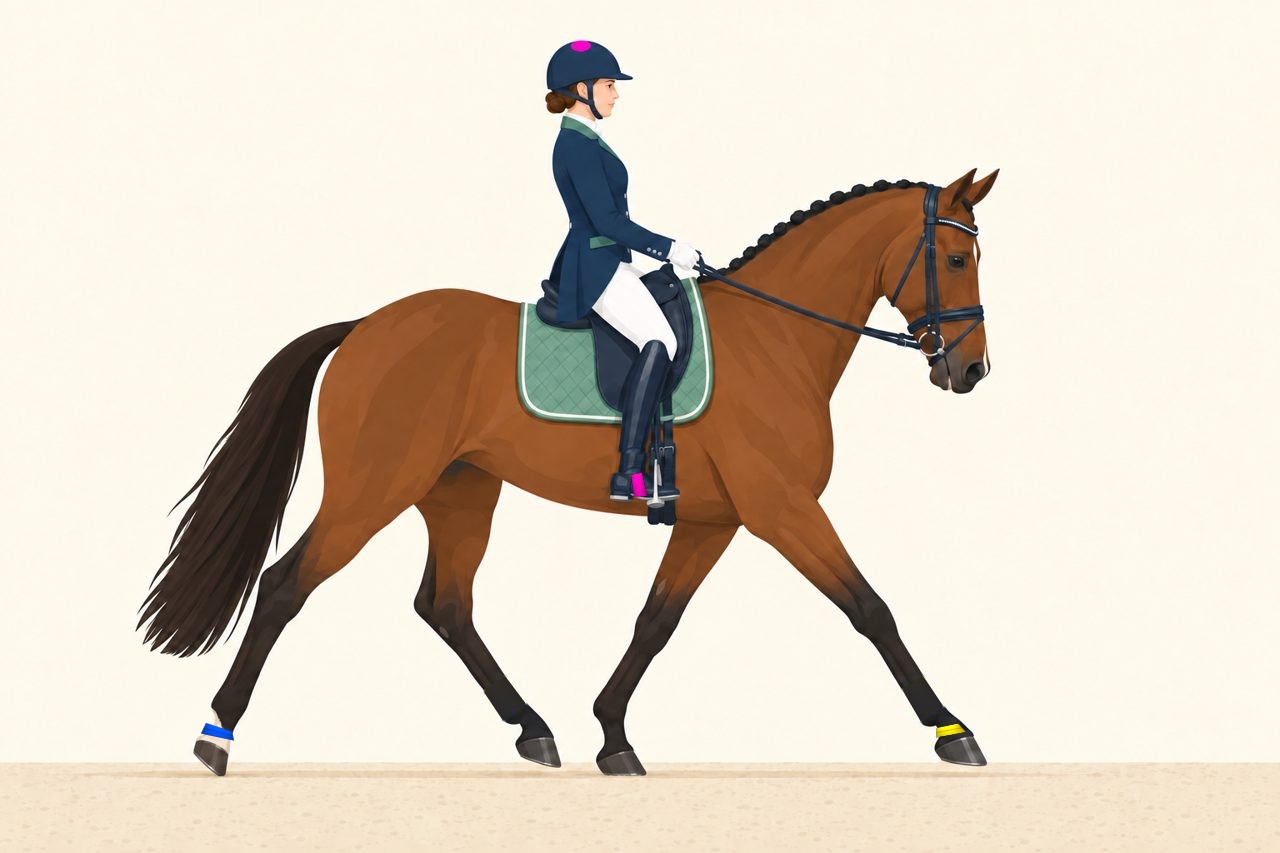
Yellow: near front leg
Wrap it around the long pastern, between the fetlock and the hoof, on the front leg closest to the camera. Used by Legs · stride length and Dressage movement.
Blue: near hind leg
Wrap the same spot on the hind leg closest to the camera. Blue stays bright in the shadow under the horse's belly, where hind legs usually are.
Pink: rider's helmet and heel
Put a small patch on top of the helmet and a band around the arch of the boot nearest the camera, just behind the stirrup. Used by SeatCheck rider tracking.
Poll & hip: no markers needed
For head-nod and hip-hike symmetry, you just tap the poll and the top of the hip. A small strip of light tape on either point can help on dark or dappled coats.
Marker tips
- Pick neon shades over pastels. Saturated color gives the tracker the strongest signal.
- Keep other pink, yellow, or blue gear out of the shot, like polo wraps, saddle pads, or jump poles. It can pull the tracker off your marker.
- Any vet wrap color works. When you tap a band, RideAlign learns that exact color and locks onto it, so the hind dot can't jump onto a differently colored front band. Best results: front and hind bands in two different colors that stand out from the coat and the footing. Tap the middle of the band.
- Put markers in the same spot every time so you can compare sessions fairly.
2. Set up the shot
- Side-on, every time. Stand square to the horse's path so you see it in pure profile. Filming at an angle shortens the stride and skews symmetry.
- Hold the phone sideways (landscape), level and at about chest or shoulder height. A tripod or fence post is even better.
- Frame the whole horse, from ears to hooves (and the rider's helmet to stirrup). Aim for the horse to fill about half the frame width.
- Follow smoothly, don't chase. Turn at the waist to keep the horse centered. Don't walk, zoom, or flip between cameras mid-clip.
- Light from behind you. Keep the sun at your back, not behind the horse. Avoid deep shade stripes and dusk.
- Sharper is better. Bright light or your phone's slo-mo mode (120–240 fps) gives crisp frames that track more reliably than blurry ones.
- Plain background if you can. A fence or wall works better than a busy line of trees, cars, or other horses.
3. Pick what to film
Trot-up (in-hand)
Have a handler trot the horse on a loose lead in a straight line on firm, level ground. Use 5–15 seconds of steady trot. Film one pass each way so you see both sides. Choose Poll & hip or Legs, then No, in-hand.
Under saddle
Film down the long side at a working trot or canter after warm-up. Use the same rein and the same spot each time. Choose your discipline (Hunter/Jumper, Dressage, or Western) so the tracker expects the right stride.
Dressage movements
Piaffe and passage: film side-on from a fixed spot, framing the horse a little wider so the legs stay in frame. Canter pirouette: stand on the outside of the turn and keep the whole horse in frame as it turns.
Rider position (SeatCheck)
Side view: the rider rides a 15–20 m circle around the person filming, who stands in the middle and turns with them. That keeps the rider side-on and the same distance away the whole time, which a straight pass along the long side can't. Keep the full body in frame, from helmet to stirrup, and film at least 10 seconds of steady trot or canter — about one full circle (10–20 seconds is ideal). Film both reins if you can. For front or back views, film straight down the centerline from the end of the arena.
Quick checklist before you hit record
Markers on: yellow on the near front, blue on the near hind, pink on the helmet and heel. Phone sideways and level. Standing square to the line. Sun behind you. Whole horse in frame. 5–15 seconds of steady movement. For SeatCheck: rider circles around you, at least 10 seconds.
Safety first. Have a handler you trust for trot-ups, keep the filmer out of the horse's path, and stop if your horse shows pain, heat, swelling, or a limp. RideAlign is a screening aid, not a diagnosis.