The clinical & coaching basis
How RideAlign reads a stride — and a riding position
The horse gait module is grounded in how equine vets assess lameness at the trot — head nod for the forelimbs, hip hike for the hindlimbs — plus stride length and rhythm read from colored leg bands, and dedicated scoring for piaffe, passage and canter pirouette. The rider position module is grounded in a simplified head-to-foot balance line, in the spirit of the classic ear-shoulder-hip-heel check, or a front/back-view read on shoulder, hip and head symmetry. Everything is measured from your video, frame by frame, on your own device — and every horse result ends with a strengthening exercise plan for the front end or the back end, while every rider result ends with in-saddle and out-of-saddle exercises for the weakest part of your position.
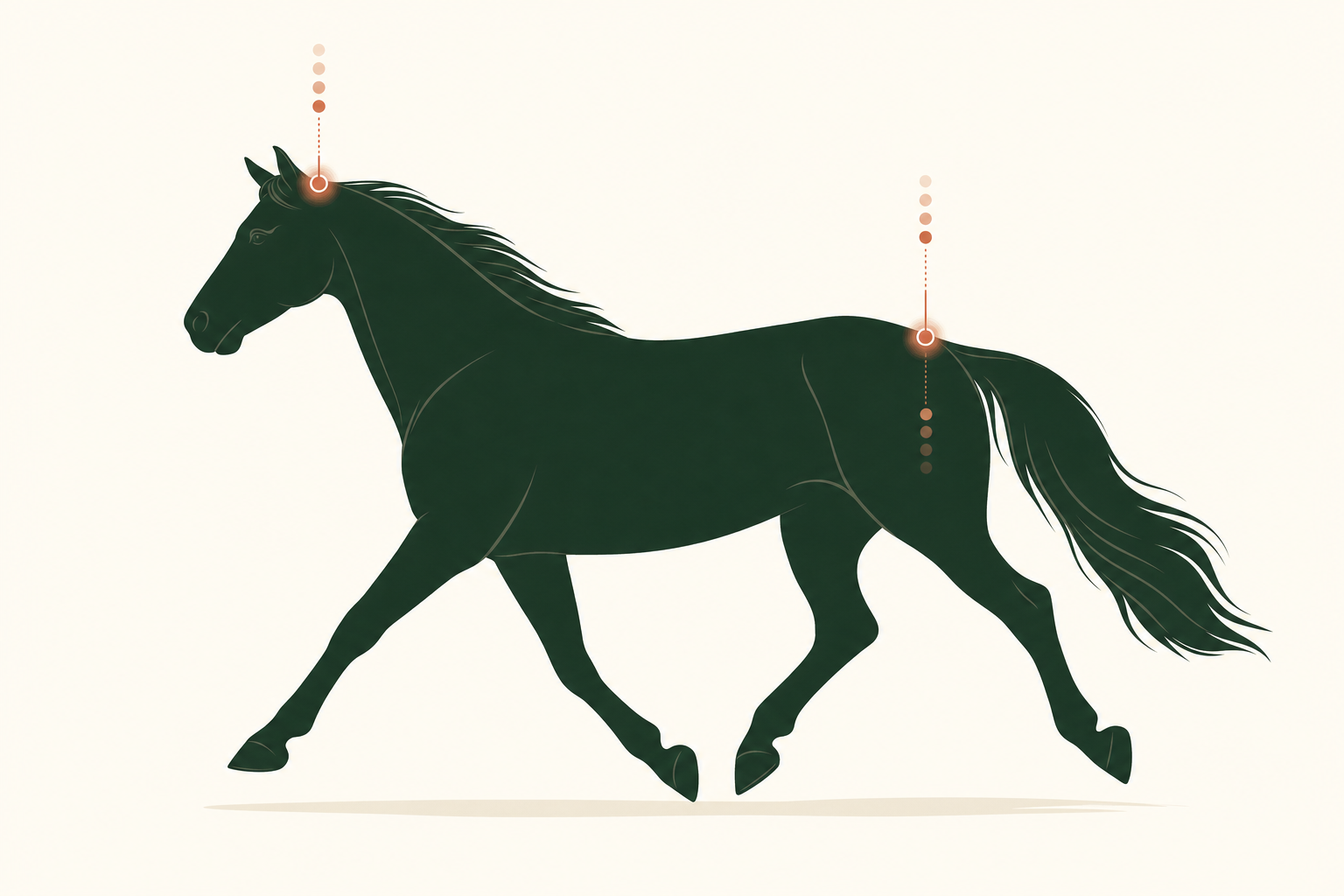
Core landmarks, two limb groups
Head nod signals forelimb. Hip hike signals hindlimb.
At a sound, symmetrical trot, a horse's poll and pelvis rise and fall in an even, repeating rhythm — each stride half mirrors the other. When a forelimb is uncomfortable, the horse typically raises its head more sharply as the sore leg lands, producing a lopsided "head nod." When a hindlimb is uncomfortable, one side of the pelvis rises more than the other during push-off, producing a "hip hike." Vets watch for exactly these two patterns during a trot-up exam — RideAlign's Poll & hip option measures them from video instead of by eye.
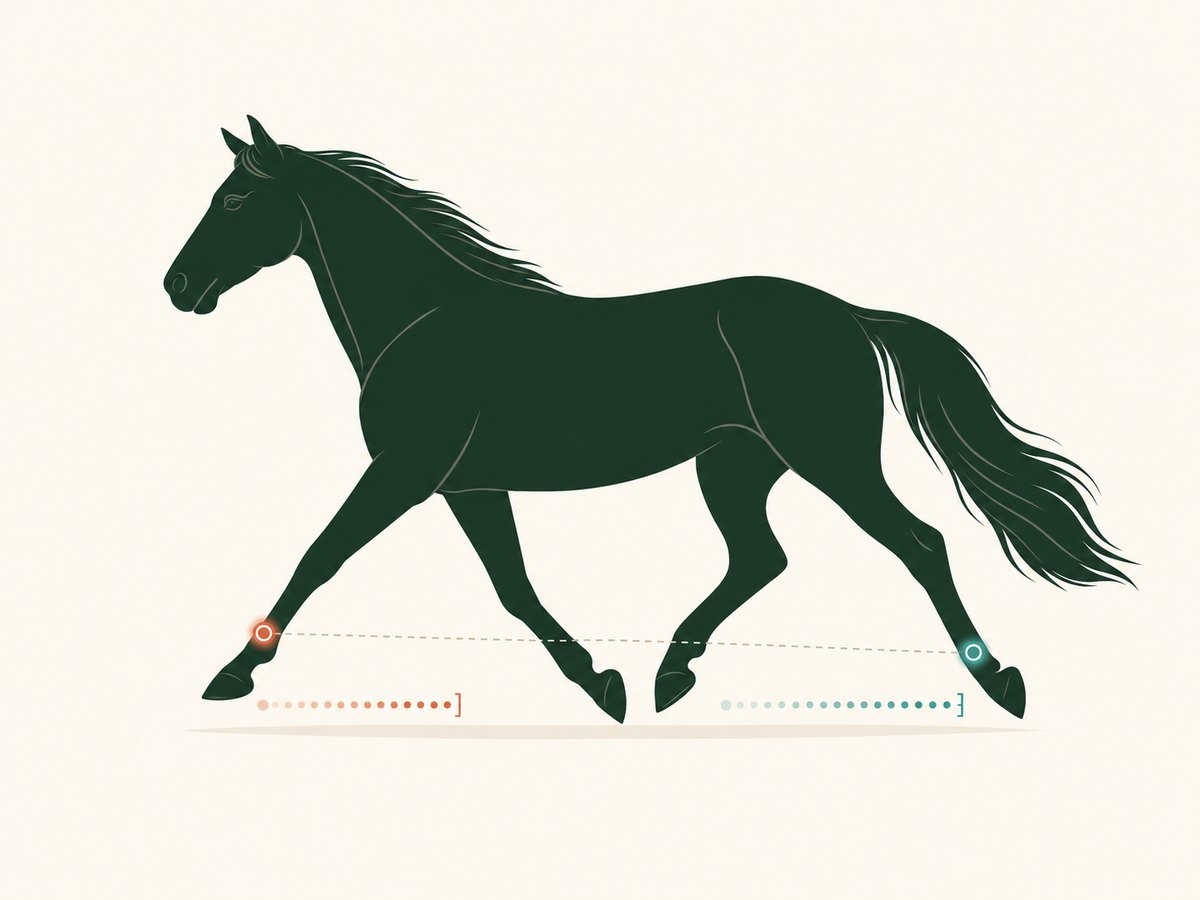
Legs · stride length
Two leg bands. How far each one travels per stride.
With the Legs option, RideAlign follows a colored band on the near front leg and another on the near hind leg, each wrapped around the long pastern. Every stride, it measures how far each band moves forward from one footfall to the next on the same leg — the front stride length and the hind stride length. The spacing between the two bands gives the horse's body length, so stride length is shown as a percentage of it rather than in feet or meters. A different color on the front and hind bands keeps the two from swapping when the legs pass each other.
Before you track
Pick a discipline, then a horse tracking option
After you upload a horse clip, RideAlign asks two quick questions. The discipline tells the tracker how the legs are likely to move, so it searches in the right place for each marker in the next frame. The tracking option decides which points you mark and which scores you get.
Hunter/Jumper
Searches wider front-to-back to follow long, forward strides.
Dressage
Allows more up-and-down travel for elevated steps in piaffe and passage; canter work uses the standard search. Also unlocks the Dressage movement option.
Western
Searches slightly tighter for a slow jog and lope with low action.
Poll & hip
You tap: the poll, then the point of the hip.
You get: poll (head nod) symmetry, hip symmetry and Stride Strength.
Best for: a straight, side-on trot-up when you're watching for lameness patterns.
Legs · stride length
You tap: the colored band on the near front leg, then the near hind leg.
You get: front and hind stride length, stride-to-stride consistency, and Stride Strength.
Selected by default — leg bands give the tracker a distinct color to lock onto and tracked most reliably in testing.
Dressage movement
You tap: the same front and hind leg bands, then choose Piaffe, Passage or Canter pirouette.
You get: tempo, rhythm, hind-lift consistency and, for piaffe and passage, diagonal timing.
These movements cover little or no ground, so stride length isn't scored.
From video to a number
What happens after you tap Track
Mark the first frame
You tap each point once — poll and hip, the two leg bands, or the rider's head and foot. For riders, Auto-detect can place the points for you with on-device AI pose estimation, and you can drag any point to fine-tune it.
Learn each marker's color
Where you tap on colored tape, a leg band or a bright heel or helmet marker, RideAlign learns that marker's own color — not the coat, sand or boot around it — and how bright it really is, so even soft pastel tape works. Plain points are followed by their look instead.
Follow every frame
In each new frame, RideAlign predicts where every point is heading from its recent motion and your chosen discipline, searches around that spot, and locks onto the best match — snapping to the learned color when there is one. Same-colored marks outside the expected area, like saddle-pad trim, are ignored.
Ask when unsure
If a point gets hidden, matches poorly, or drifts too far from where it was last confirmed, tracking pauses for a quick check so you can confirm or drag it back. A hidden leg band stays on the leg instead of wandering up the horse.
Clean out tracker slips
Before anything is scored, each frame is checked against the frames around it and the clip as a whole. A sudden jump that snaps back — the tracker losing its place, not real movement — is filled in from the good frames on either side. Smooth sways and lasting changes are left alone, and if too much of a clip would be flagged, the original data is kept.
Score & recommend
Each point's motion becomes a curve. RideAlign finds the repeating stride cycle, compares stride halves for symmetry, measures stride length and rhythm, or reads lean and sway for riders, and plots one stride against a perfectly even reference. For horses, it then picks the weaker end — front or back — and gives you a strengthening exercise plan for it.
Getting the best tracking
Bright markers are the biggest single improvement
Our tip: use vet wrap for color markers
We recommend brightly colored vet wrap (self-adhesive bandage) for your tracking markers. It holds on its own and won't leave residue on your boots or helmet. On the horse, wrap it around the long pastern bone — between the fetlock and the hoof — so boots or polo wraps won't get in the way.
Use colors that stand out
Pick tape or bands that don't match the horse's coat, the footing or the tack. Vivid colors hold up best in sun and at speed; very pale shades can wash out to almost white outdoors.
Front and hind in different colors
A different color on the front and hind legs keeps the two points from swapping when the legs cross at trot and canter.
Mark the rider's heel and helmet
A bright band around the arch of the boot, and a sticker on a dark helmet, give SeatCheck something distinct to lock onto against trees, fences or a panning background.
Film close, side-on and steady
5–15 seconds, horse filling a good part of the frame, camera at roughly shoulder height. Brighter light or your phone's slo-mo mode gives sharper frames.
Reading the horse scores
Symmetry Index — three bands, plainly worded
Looks symmetrical
Left/right movement is close to even. A balanced mix of front-end and back-end exercises keeps it that way.
Mild asymmetry — worth monitoring
A small but measurable difference between step halves. Start the recommended exercises, re-screen in a week or two and watch the trend.
Notable asymmetry — start a strengthening plan
A clearer difference between step halves. Follow the recommended exercises for the weaker end and re-screen to track the change.
When the poll shows more asymmetry than the hip, RideAlign notes a pattern consistent with forelimb involvement; when the hip shows more, it notes a pattern consistent with hindlimb involvement. RideAlign never names a specific limb and never gives a diagnosis. Instead, it uses that pattern to recommend exercises for the front end or the back end of the horse.
Beyond symmetry
The Stride Strength Index
Symmetry only compares left vs. right. Stride Strength looks at rhythm instead: how consistent the timing between strides is (cadence), and how consistent the push-off amplitude is from one stride to the next. It's available with both Poll & hip and Legs tracking. A horse with even, repeatable strides scores high; one with irregular timing or uneven push-off — which can reflect fatigue, mild discomfort, uneven footing, or an inconsistent gait — scores lower. It's a screening signal, not a fitness or strength diagnosis. Even sound horses vary a little from stride to stride, and video timing adds a little more, so the first 4% of variation in stride timing and 6% in push-off counts as fully regular before the score starts to drop.
Strong, regular push-off rhythm
Cadence and amplitude are consistent from stride to stride.
Somewhat uneven rhythm — worth monitoring
A measurable amount of stride-to-stride variability. The recommended exercises target the weaker end.
Irregular rhythm — focus on strength work
Noticeable inconsistency in timing or push-off strength. Follow the strengthening plan and re-screen to track the change.
Recommended exercises
Every horse result comes with a strengthening plan
RideAlign looks at which end of the horse came out weaker in the clip and recommends exercises for it. With Poll & hip, the less even of the two points decides; with Legs, it's whichever of the front or hind strides was less consistent; in a Dressage movement, hind-lift consistency points to the back end. If everything reads well, you get a balanced mix to keep both ends strong.
Front end
Raised trot poles, slow downhill walking, shoulder-fore and shoulder-in, baited stretches, and long-and-low stretching trot — to build the shoulders, chest, forearms and base of the neck so the horse lifts and reaches through the front end.
Back end
Uphill work, rein-back, walk–trot and trot–halt transitions, ground poles and cavaletti, and leg-yield and haunches-in — to build the hindquarters, stifles and hocks so the horse pushes and carries more evenly from behind.
Each plan suggests 3–4 sessions a week, about 10–20 minutes of focused work, built up over 4–6 weeks, and a re-screen every 1–2 weeks with the same filming setup so you can see whether the scores move. Strength work is for a comfortable horse — if your horse is sore, uneven at the walk, or has heat or swelling in a leg, stop and rest it.
Legs & dressage movement
Stride length, and what judges look for in collected work
Front & hind stride length
How far each near-side band travels per stride, shown as a percentage of the horse's body length (the spacing between the front and hind bands), with a stride-to-stride consistency reading underneath. Consistency uses the same 85% / 65% bands and the same small allowance for normal stride-to-stride variation as Stride Strength.
Stride length is relative, not feet or meters — RideAlign has no camera calibration, so it's best for comparing the same horse over time with a similar filming setup.
Dressage movement scores
Tempo: strides per minute against published reference ranges — about 50–62 for piaffe and passage, 60–78 for a canter pirouette.
Rhythm: how even the stride-to-stride timing is.
Hind-lift consistency: how evenly the hind leg lifts every stride.
Diagonal timing (piaffe and passage): whether the near fore and near hind alternate half a stride apart, as a correct two-beat diagonal movement should.
Front and hind lift height are shown for reference. The overall movement score reads Strong at 80+, Developing at 60–79, and Needs work below 60.
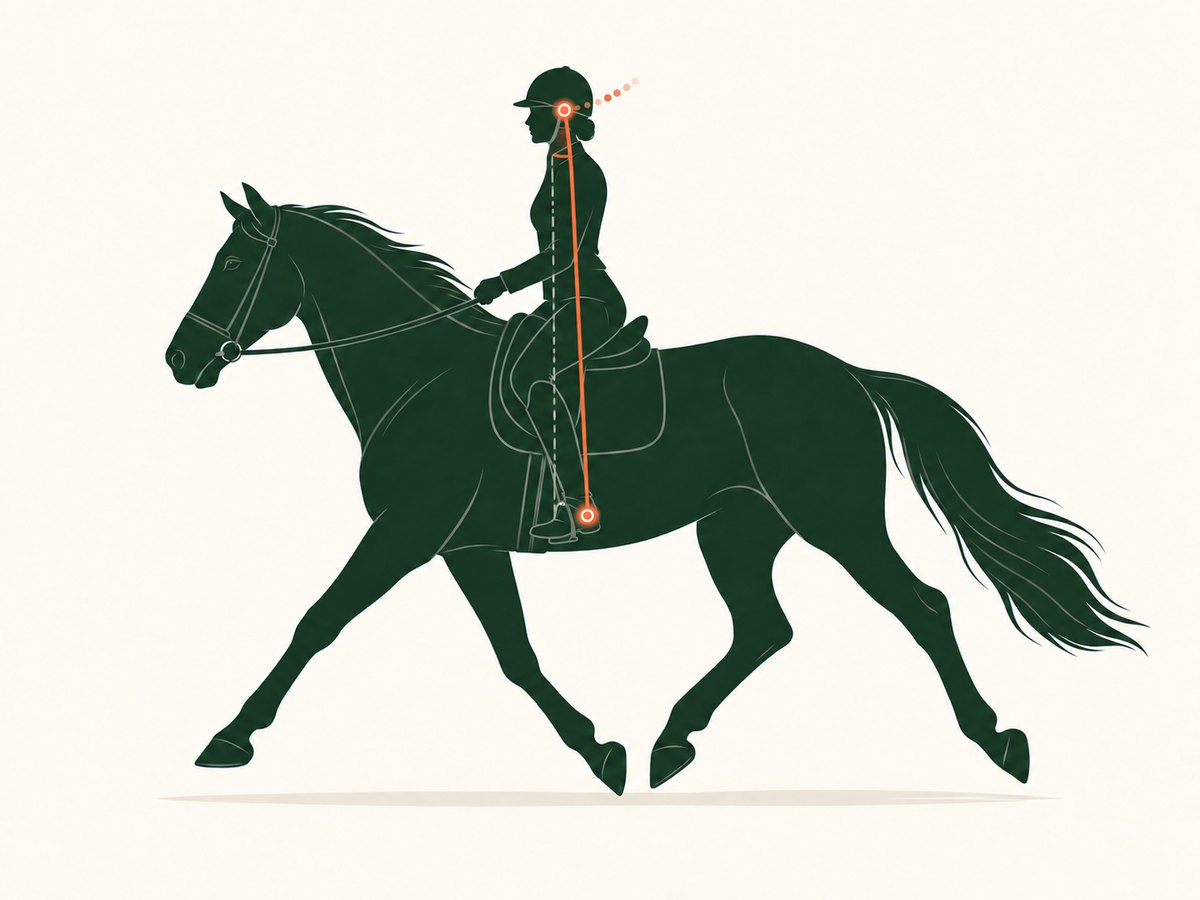
The rider position module · side-on
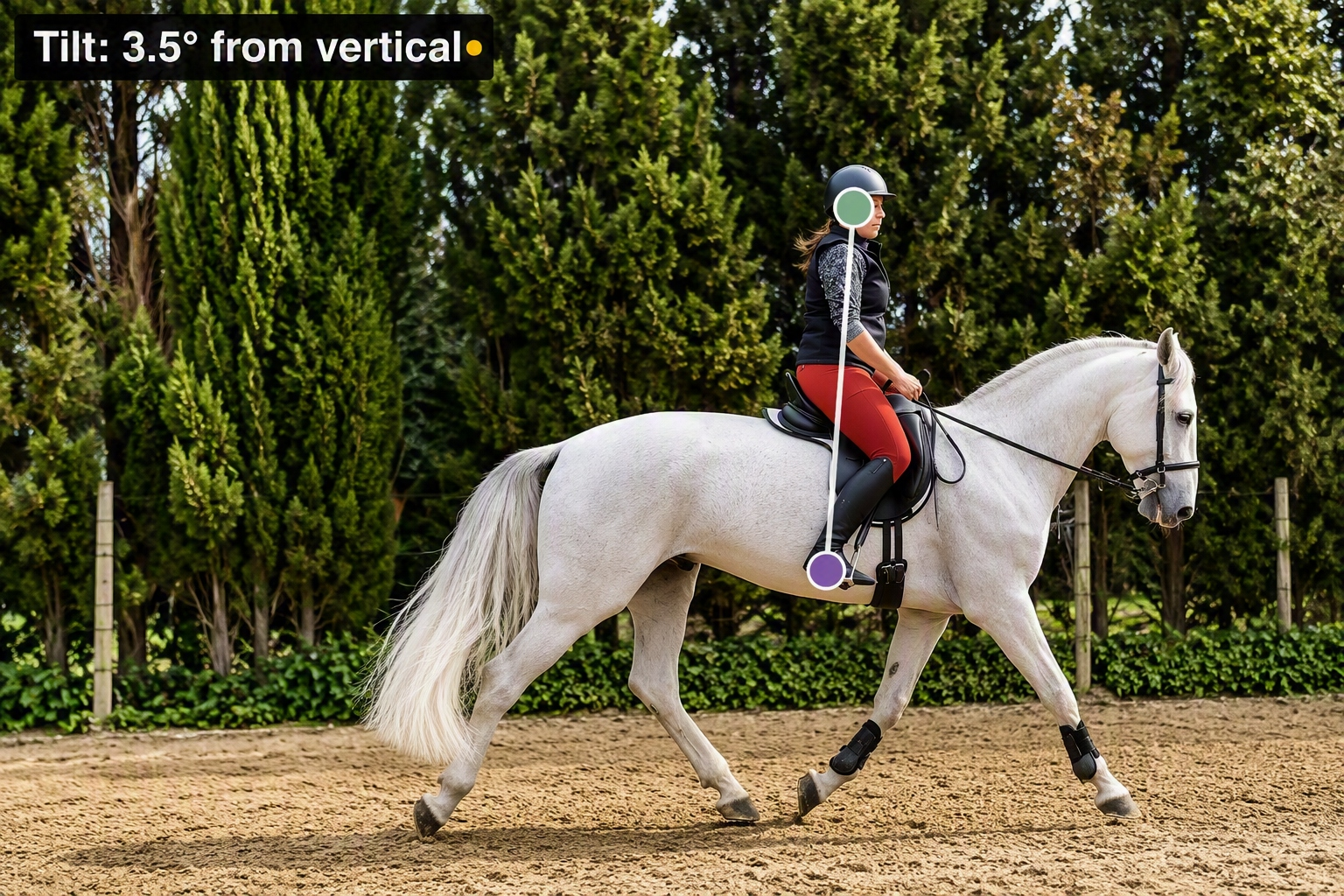
Head to heel, measured against true vertical.
Riding instructors have long used the ear-shoulder-hip-heel line as a quick visual check of a rider's balance in the saddle. From a side-on clip, RideAlign tracks two points — head and foot — to measure how far a simplified head-to-foot line tilts from vertical on average (Alignment) and how much it sways frame to frame (Stability). The live tilt reading is drawn on the tracked video so you can see exactly where the lean happened.
Rider body lock. A rider's head and heel move with the horse, so SeatCheck follows a few hidden points down the rider's torso, seat and thigh first, then carries the head and foot along with them before fine-tuning each one. That keeps the points on the rider when the camera pans, instead of sliding onto the trees or fence behind a dark helmet. A bright heel or helmet marker is followed by its color. And because a real rider's head-to-heel line only leans and stretches so much, any frame where it goes past those limits holds the weaker point back — and asks you for a quick tap if it keeps happening.
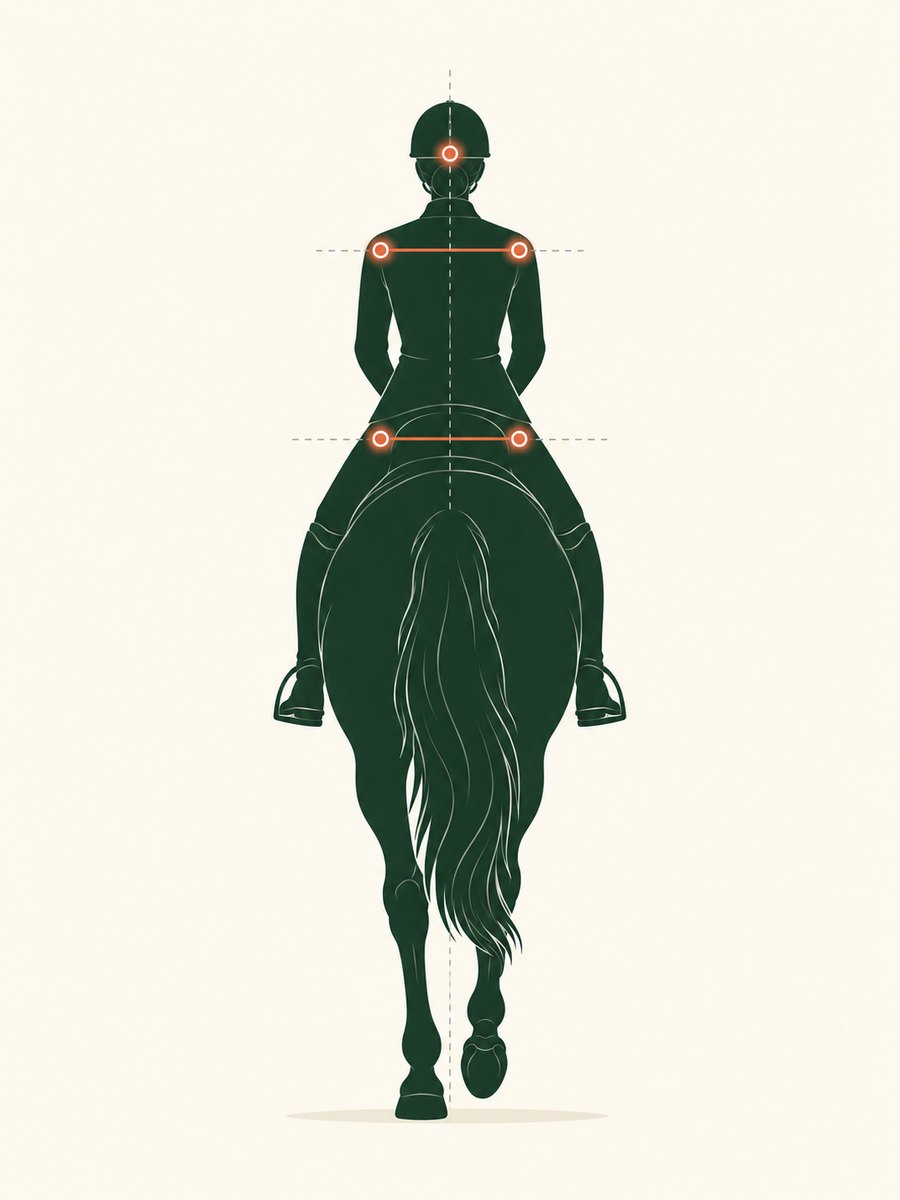
The rider position module · front or back-on
Level shoulders, level hips, head centered.
From a front or back-on clip, RideAlign instead tracks five points — both shoulders, the head, and both hips — to measure Symmetry Score. Shoulder Symmetry reads how level the line between the shoulders stays, Hip Symmetry does the same for the hips, and Head Centering checks how close the head sits to the midpoint between the shoulders. Film with the horse moving straight toward or away from the camera so both sides of the rider stay in view.
Reading the rider scores
Every rider score, in plain language
Well balanced / Steady
The head-to-foot line stacks closely and holds steady through the clip.
Slight lean / Some wobble — worth a coach's eye
A measurable but modest amount of lean or sway.
Noticeable lean / Unsteady — consider a balance-focused lesson
A clearer amount of lean or sway worth addressing with a coach.
Alignment, Stability, and the three Symmetry Score readings (Shoulder, Hip, Head Centering) all share this same three-band scale. Alignment treats an average lean of up to 6° as upright, to allow for where the head marker sits on the helmet and for a slightly off-level camera, then reaches zero at 22° from vertical. Tracker slips are removed before any rider score is calculated, so a moment where a point lost its place doesn't drag your score down. Every rider screening is saved to that rider's history, where you can pick any two past screenings and see the exact change between them — so you can track whether recent lessons or practice are actually moving the needle.
Meet the toolkit
What GaitTrace, SeatCheck, Symmetry Score, and Progress Tracker actually measure
These are our names for specific measurements inside RideAlign — not separate products, sensors, or medical devices. Every one of them is a proxy computed from the same tracked video points described above, run through simple, published-style math. None of it is calibrated against clinical instruments, and none of it runs in true real time — every clip is analyzed frame by frame after you record it.
GaitTrace
Tracks: the poll and hip, or colored bands on the near front and hind legs, to measure stride length, stride frequency, rhythm and push-off consistency — plus tempo, rhythm, hind lift and diagonal timing for piaffe, passage and canter pirouette. Every result comes with a front-end or back-end exercise plan.
Caveat: frame rate, video quality and marker visibility directly affect precision — it's a rhythm and proportion estimate, not a force-plate or calibrated distance measurement.
SeatCheck
Tracks: a simplified head-to-foot vertical line, in the spirit of the classic ear-shoulder-hip-heel check, and how much it tilts or sways on side-on rider clips — with rider body lock keeping the head and heel on the rider.
Caveat: depends on a clean side-on camera angle; loose clothing or a partially blocked view can shift the marked points.
Symmetry Score
Tracks: left-to-right comparison of the horse's poll and hip movement to flag uneven loading; on front/back-on rider clips, tracks shoulder tilt, hip tilt, and head centering instead.
Caveat: a screening signal only — many non-lameness or non-position factors (footing, turns, camera angle) can also create asymmetry.
Progress Tracker
Tracks: every saved screening for a horse or rider, laid out as a multi-session heatmap and trendline. Scores already saved keep the values they were given at the time.
Caveat: trends are only as reliable as the consistency of your filming setup session to session.
Honest about where we are
What RideAlign does today vs. what's on the roadmap
RideAlign today pairs one-tap marking with color-aware, motion-predicting tracking that runs entirely in your browser — and it asks you for a quick check rather than guessing when it's unsure. We'd rather ship something transparent and correct than overclaim a full AI horse pose model we haven't built yet. Products like Sleip, RealHorse, Lameness Locator, and Ultralytics' Stride app point toward where fully automated pose tracking can go — that's Phase 2 for us, not a claim we make today.
Today
- Choose Poll & hip, Legs, or Dressage movement tracking
- Front-end or back-end strengthening exercises with every horse result
- Discipline setting (Hunter/Jumper, Dressage, Western) guides the tracker
- Learns each marker's color from your tap and locks onto it
- Rider body lock keeps head and heel on the rider
- On-device AI auto-detect for rider points
- Tracker slips removed before scoring
- Runs fully on-device, in your browser
Phase 2 — roadmap
- Automatic horse pose detection (no manual tapping)
- Stride prediction that carries leg markers through fast canter work
- Additional landmarks (withers, croup, fetlocks)
- Dressage — suspension time in the air
- Jumpers — scope of the jump
- Hunters — trot and canter rhythm scoring
- Still a screening and training aid — not a diagnosis
RideAlign's horse gait module is a screening and monitoring aid, not a diagnosis. It recommends exercises to build strength in the front or back end of your horse — build up gradually, and stop and rest your horse if it shows pain, heat, swelling or a limp. RideAlign's rider position module is a self-coaching aid, not a substitute for in-person instruction. Always work with a qualified riding coach or trainer to address position or safety concerns.